
Ask ten car owners what “detailing” means and you’ll probably get ten different answers. Some picture the $15 wash-and-vacuum special at a gas station. Others imagine someone spending an entire afternoon polishing a hood until it mirrors the sky. The real answer sits much closer to the second description, and understanding why matters if you’re trying to figure out where to spend your time – or your money – on caring for a car.
Detailing Is Not the Same as Washing
A wash removes what’s sitting on top of the paint: dust, pollen, road grime, the occasional bug strike. It’s fast, it’s necessary, and it does very little to address what’s happening underneath that layer of dirt.
The International Detailing Association, the trade group that sets training and certification standards for the profession, draws a clear distinction between the two: washing clears away surface contamination, while detailing is a more deliberate process built around restoring a vehicle’s surfaces and protecting them from further damage.
That distinction is why a proper detail costs more and takes longer than a drive-through wash – you’re not paying for the same service scaled up, you’re paying for a different kind of service altogether.
Exterior detailing specifically covers everything a car presents to the outside world: paint, wheels, tires, glass, trim, and the various rubber and plastic components on the body. Interior detailing is its own separate discipline, dealing with upholstery, carpets, and the dashboard. The exterior process is usually what people mean the first time they ask about getting a car detailed.
What a Full Exterior Detail Actually Includes
The steps below are fairly standard across the industry, though the order and the specific products used vary from shop to shop.
Pre-rinse and foam wash. The process starts by loosening dirt with a pressure rinse, followed by a foam pre-soak that lifts grime before anything touches the paint directly. Many detailers then use a two-bucket wash method – one bucket for soapy water, one for rinsing the mitt – specifically to keep grit from being dragged back across the surface and causing fine scratches.
Wheel and tire cleaning. Wheels collect brake dust, which is mildly corrosive and clings stubbornly to metal. A dedicated wheel cleaner and separate brushes, kept apart from the paint-safe tools, address that, along with a tire dressing to restore a clean, non-greasy finish on the sidewalls.
Decontamination. This is the step that really separates a detail from a wash. Even after washing, paint often holds onto bonded contaminants – tar, tree sap, industrial fallout, tiny embedded metal particles from brake pads – that soap alone can’t touch. Detailers use a clay bar, clay mitt, or chemical iron remover to pull these out, leaving a surface that’s smooth rather than gritty to the touch.
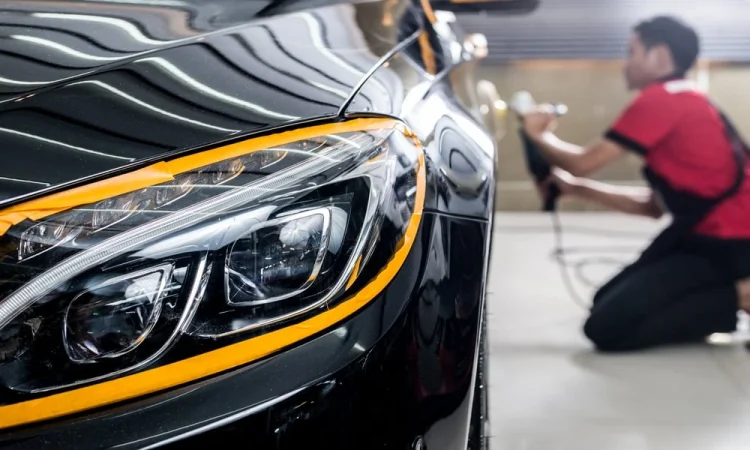
Paint correction and polishing. Once the surface is clean and decontaminated, a detailer can properly assess it for swirl marks, light scratching, and oxidation.
Machine polishing, sometimes with several passes using different pad-and-compound combinations, levels out these imperfections and restores gloss by removing a thin layer of clear coat. Not every detail includes this step; it depends on the paint’s condition and what the customer is willing to spend.
Protection. This is where wax, paint sealant, or ceramic coating comes into play. Each trades off differently between cost, durability, and the amount of shine it adds. A carnauba wax might last a couple of months and give a warm, deep look.
A synthetic sealant can hold up for roughly six months. A ceramic coating, applied correctly, can protect the paint for a year or more, though it costs more and needs more prep work beforehand.
Trim, glass, and final details. The last stage covers plastic trim restoration – bringing faded black trim back to a rich black instead of a chalky gray – glass cleaning inside and out, and a final wipe-down and inspection before the car changes hands.
Why the Extra Steps Are Worth It
Paint sitting under regular sun exposure doesn’t just fade for cosmetic reasons. Ultraviolet rays gradually break down the clear coat’s protective structure, which is what eventually leads to oxidation, a chalky finish, and in bad cases, cracking. A wax or sealant layer acts as a sacrificial barrier that absorbs some of that damage instead of the clear coat itself.
Skipping protection doesn’t cause immediate harm, but it does mean the paint is doing all the work of resisting UV rays, road salt, bird droppings, and tree sap on its own – which shortens how long it keeps looking good. There’s also a practical side to this: a well-kept exterior tends to matter at resale or trade-in time, when a buyer’s first impression is almost entirely visual.
Professional Detailing vs. Doing It in the Driveway
It’s entirely possible to get decent results with a hose, some car shampoo, and a free Saturday afternoon. What’s harder to replicate at home is the equipment – dual-action polishers, extraction tools, professional-grade decontamination products – and the wastewater side of things.
Washing a car in the driveway is more consequential than it looks: that soapy, oily runoff typically flows straight into the nearest storm drain and from there into a local creek, river, or bay without passing through any treatment plant, a pattern the EPA has pointed to as one of the more overlooked, unregulated sources of everyday water pollution. Professional shops and mobile setups are generally built to capture and manage that wastewater properly, which is easy to overlook when weighing DIY against paying someone else.
Mobile detailing has also made professional-grade service more accessible for people who’d rather not haul a car across town. Some operators, like Cargo Detailing, now bring the equipment and water setup directly to a driveway or office parking lot, which removes a lot of the friction that used to keep people doing it themselves out of convenience rather than preference.
How Often Does a Car Need One?
There’s no single answer, since it depends heavily on climate and how the car is stored. A vehicle parked outdoors in a hot, sunny region and driven daily is under far more stress than one that mostly lives in a garage.
As a general range, a full exterior detail every three to six months keeps most vehicles in reasonable shape, with a quicker maintenance wash in between. Cars with a ceramic coating can often stretch that interval further, since the coating is already doing a lot of the defensive work.
What to Look for When Choosing a Detailer
Not every shop structures its services the same way, so it helps to know what’s actually included before booking anything. A well-built exterior detailing package usually spells out which of the steps above are covered – decontamination and polishing in particular are easy to skip without a customer noticing until later. Asking a shop to walk through their process, rather than just quoting a flat price, tends to reveal a lot about how thorough the work will actually be.
The Bottom Line
Exterior detailing isn’t an upgraded car wash so much as a layered process aimed at restoring a vehicle’s surfaces and then protecting that work from the elements. Whether that means an occasional deep clean or a standing maintenance schedule depends on the car, the climate, and how much the owner cares about keeping the paint looking the way it did on day one. Either way, knowing what’s actually involved makes it a lot easier to tell a genuine detail from a wash with a fancier name.