
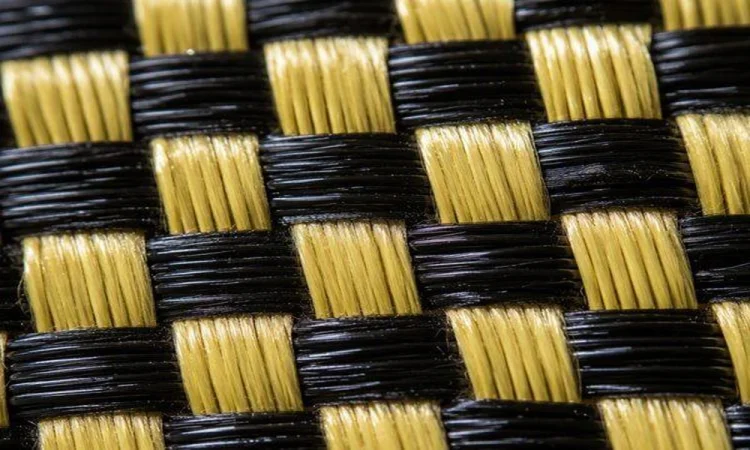
Carbon Kevlar hybrid weave, the black-and-gold checkerboard explained below.
If you are shopping for your first carbon fiber parts, the listings can feel like a foreign language. Twill, forged, dry carbon, and then. Wait, why is this one gold? This guide translates the three material options you will actually run into, with no engineering degree required.
Carbon Fiber: the Default for a Reason
Carbon fiber is exactly what it sounds like: threads made of almost pure carbon, woven into fabric and set in resin. Its superpower is stiffness. It holds its shape under load better than almost anything you can bolt to a car, at a fraction of the weight of metal. If you have ever pressed on a carbon hood and felt that rock-solid rigidity, that is the whole trick.
Its weakness is sudden failure. Carbon does not bend much before it breaks, about one and a half percent of stretch, so a hard enough impact cracks it instead of denting it. For most parts most of the time, that trade is completely fine. It is why carbon is the default.
Kevlar: the Tough One
Kevlar is a different fiber entirely. An aramid, best known from bulletproof vests. Where carbon is stiff, Kevlar is tough: it stretches two to four percent before breaking, soaking up hits that would crack carbon in half. You will rarely see a full Kevlar body panel, because it is too flexible for that job and oddly weak in compression. But in places that get struck constantly, undertrays, rally protection, leading edges, it is close to unbeatable. Think of carbon as glass that learned to be light, and Kevlar as leather that learned to be structural. Neither metaphor is perfect, and both are more useful than most spec sheets.
Carbon Kevlar Hybrid: the Best of Both, at a Price
The black-and-gold checkerboard fabric is both materials woven together: carbon threads for stiffness, golden Kevlar threads for impact resistance. The result is a part that stays rigid like carbon but survives strikes like Kevlar. It costs more, the aramid fiber itself is pricier, and the layup work is slower, but for splitters, bumper lips, and rocker panels on cars that actually get driven, it is often the smart money. The carbon Kevlar vs carbon fiber comparison has the full numbers if you want to go deeper.
So What Should Your First Parts Be?
- First upgrade, low risk: mirror caps or a rear spoiler in plain carbon. Safe placement, visible result, sensible price.
- Lowered street car: front lip or splitter in hybrid weave. It will meet a curb eventually, and you will be glad.
- Track or gravel use: hybrid on anything low, and read up on construction quality. The dry carbon vs wet carbon difference affects strength and price as much as the fiber does.
- Pure style play: plain twill is the classic, and forged carbon fiber is the wildcard with the marble look.
Reading a Listing Like a Pro
Product listings tell you more than they intend to once you know the vocabulary. ‘Carbon look’ or ‘carbon style’ means printed plastic, walk away. ‘Wet carbon’ means hand-laid resin, heavier and less consistent, fine for budget builds if priced accordingly. ‘Dry carbon’ or ‘prepreg’ means factory-controlled resin content, lighter and stronger, and priced accordingly. ‘Hybrid weave’ should mean actual aramid threads, not gold-tinted fiberglass. Ask what the gold fibers are made of, and a serious seller will answer instantly. The thirty seconds you spend decoding a listing is worth more than an hour of reviews.
Your Second Order
The first part teaches you more than any guide can: how the weave looks in your garage light, how the edges are finished, how the seller communicates when you ask a hard question. Use that. If the first part impressed you, the second order is where you get deliberate. Matching weaves across panels, choosing hybrid only where the car needs it, maybe stepping up to a full aero package. Builders who plan the second order while installing the first end up with cars that look designed rather than decorated. That is the whole game.
Two Things Nobody Tells First-Time Buyers
One: if the part shows gold weave, it needs UV protection. Aramid fibers degrade in sunlight, so a quality clear coat is not optional on hybrid parts. Two: fitment beats material. A perfectly chosen weave on a part that fits badly is still a bad part. Buy from makers who show real fitment photos on real cars.
Start with one part, learn how it lives on your car, and go from there. The vocabulary that felt like a foreign language today will feel obvious by your second order. And when someone at a meet asks why you chose the gold weave, you will have a better answer than ‘it looked cool’. Even if that was part of it.